

Early access
Bring the calm home.
One plan covers both homes. A hello, the odd update, and one email when it's your turn.
Almost there. Check your email and tap the link to confirm. 
Free during early access · one plan covers both parents · unsubscribe anytime
Co-parenting · money after separation
Child costs after separation: who pays for what?
Shoes, school trips, clubs, childcare, prescriptions — after separation, the question is rarely just “how much?”. It is what counts as everyday support, what needs a shared decision, and how you keep it fair without turning every receipt into an argument.
This is general information for UK parents, not legal or financial advice. For child maintenance rules or calculations, start with GOV.UK or a qualified adviser.
- Plain English
- UK-focused
- No maintenance calculator

The first split
Separate child maintenance from shared extras.
Most money rows start because two different things get mixed together. Keep them separate and the conversation becomes calmer.
-
Child maintenance
Regular support for a child’s everyday living. It may be arranged privately between you or through the Child Maintenance Service. The Child Maintenance Service covers England, Wales and Scotland; in Northern Ireland the equivalent is run through nidirect. We do not explain or calculate it here — GOV.UK is the right starting point.
-
Shared extras
The additional costs that pop up around real family life: clubs, trips, uniform, equipment, childcare cover, medical bits, travel and activities. These need an agreement you both understand.
-
Parent-choice costs
Sometimes one parent chooses something for their time — a day out, a toy, a treat. Not every spend has to be split. Agree which costs are “shared” before anyone buys them.
GOV.UK: Child Maintenance Service → · nidirect: child maintenance (Northern Ireland) → · Read about the proposed CMS income-rule change →
What to agree first
The costs worth naming in advance.
You do not need a legal-looking document. You need a plain list that says what you will share, how you will split it, and when a parent needs to ask first.
-
School and childcare
Uniform, shoes, school trips, wraparound care, holiday clubs, revision books and anything the school asks for that sits outside normal day-to-day spending.
-
Clubs, sport and activities
Karate, swimming, football, music lessons, subscriptions and kit. Agree whether both parents must say yes before a new recurring cost starts.
-
Health, dental and practical bits
Glasses, private or otherwise chargeable health costs, toiletries for handovers, travel and the extra things that are easy to forget until one parent has paid again.
-
A spending threshold
Pick a figure where anything above it needs a quick yes before it is bought. It stops surprise bills without making every small item feel like a negotiation.
Fair ways to share
Choose the split before the receipt appears.
The fairest split is the one you both understand and can keep using. These are the common patterns.
-
50/50
One simple option when your circumstances are similar and you both agree you want the fewest decisions.
-
By income or affordability
One parent pays a higher share because their income or circumstances make that fairer. Review it when work, housing or childcare changes.
-
By category
Different splits for different things: school costs one way, activities another, medical costs another. Helpful when the same costs repeat.
Keep it tracked
Make the record calmer than the argument.
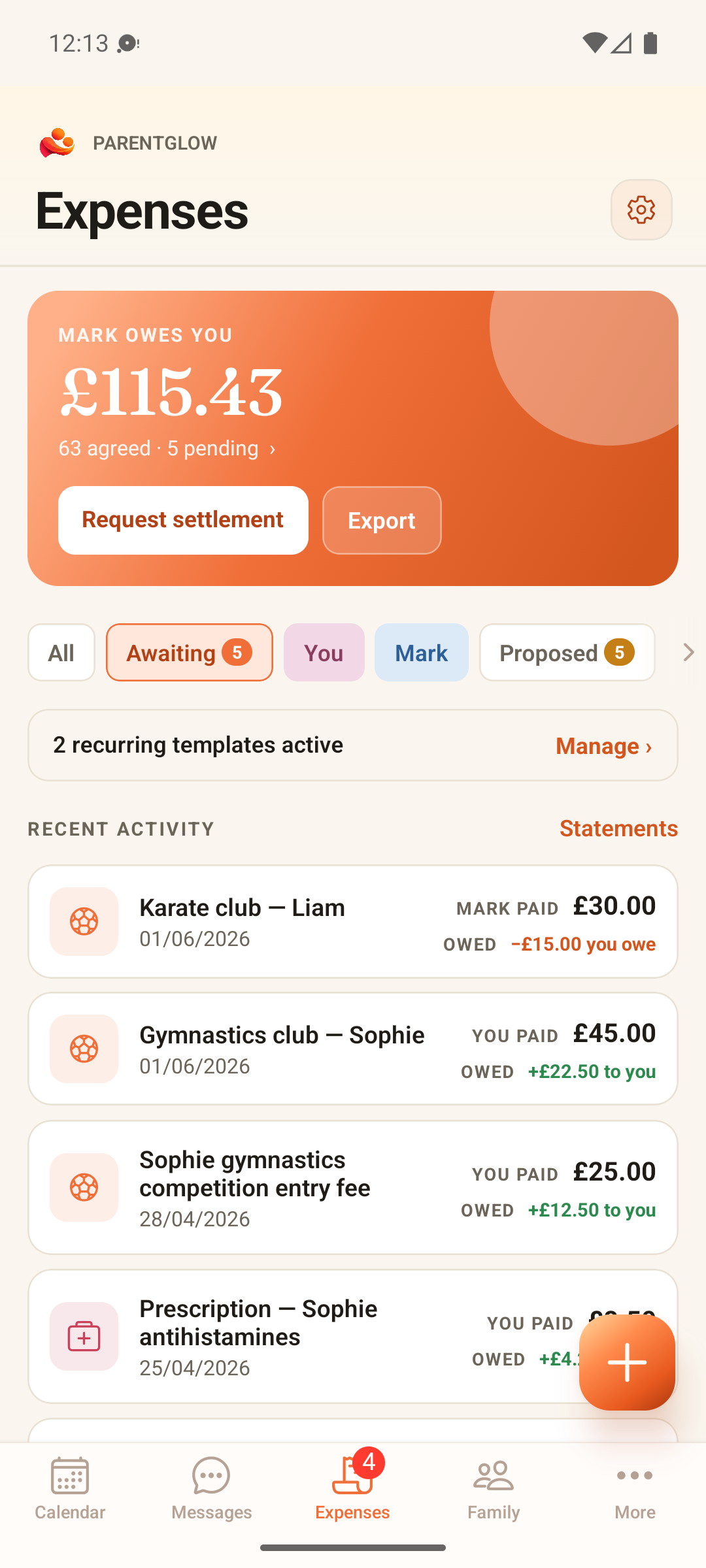
Once the agreement is clear, the real work is keeping a fair record. ParentGlow lets either parent log a cost, attach the receipt, apply the split you agreed and see one running balance.
That means “who paid for the school shoes?” has an answer. Recurring costs do not need to be remembered from scratch. Bigger spends can wait for a yes. And if you need to settle up, you are looking at the same numbers, not two different lists.
Quick answers
Questions parents ask about child costs after separation.
-
Who pays for children’s costs after separation?
There is not one everyday rule for every family. Some costs are covered by child maintenance, some are shared extras, and some are paid by the parent who chooses or books them. Name the types of cost, agree which ones need a shared decision, and keep a clear record of what each parent paid.
-
Are child costs the same as child maintenance?
No. Child maintenance is regular support for a child’s everyday living, arranged privately or through the Child Maintenance Service. Shared extras are things like uniform, clubs, trips, childcare cover and medical bits you agree to split on top. For maintenance rules and calculations, use GOV.UK or professional advice.
-
What costs should separated parents agree in advance?
Agree the recurring and bigger costs first: clubs, childcare, school trips, uniform, health costs not covered by the NHS, phones or travel, and anything above a spending limit you choose together. Small everyday costs can follow the pattern you already agreed.
-
How can co-parents avoid arguments about money?
Put the agreement in writing, set a spending threshold, attach receipts, and keep one shared running balance. That way the conversation is about the child and the agreement, not about memory, screenshots or a pile of old receipts.
Not sure whether to deal with child arrangements or finances first? Read our plain-English guide to the separate questions.
Bring the calm home.
Free during early access — a hello, the odd update, and one email when it's your turn.
Almost there. Check your email and tap the link to confirm.
Free during early access · one plan covers both parents · unsubscribe anytime