

Early access
Bring the calm home.
One plan covers both homes. A hello, the odd update, and one email when it's your turn.
Almost there. Check your email and tap the link to confirm. 
Free during early access · one plan covers both parents · unsubscribe anytime
Co-parenting · sharing the costs
Splitting the children's costs, fairly.
Uniform, clubs, kit, prescriptions, the school trip that lands out of nowhere — the children's costs add up, and when you're separated they're easy to argue about. Here are the fair, practical ways UK parents share those costs, how to agree the big spends before they happen, and how this is different from child maintenance. Agree it once, keep it tracked, and stop totting up receipts from memory.
This is general information, not legal or financial advice.
- Fair & simple
- Receipts attached
- One running balance

What we're talking about
What “the children's costs” actually means.
It's the everyday spending plus the bigger one-offs — separate from where the children live and how their time is split. Naming it helps, because then you're splitting a clear list, not a vague sense of “stuff”.
-
The everyday
School uniform and shoes, clubs and lessons, sports kit, prescriptions, packed-lunch bits, the bus pass — the steady drip of small spends.
-
The bigger one-offs
The school residential, a new coat, a birthday party, exam-revision guides, the dentist trip that isn't free — costs that turn up now and then and sting a bit more.
-
Childcare & cover
Wraparound care, holiday clubs and the odd babysitter so you can both work — practical costs that are easy to forget when you tot it all up later.
-
Not the same as “who they live with”
Sharing the costs is its own thing, separate from the child arrangements and contact pattern. You can split the spending fairly whatever the week-to-week looks like.
The fair ways
Fair ways to split them.
There's no single “right” split — fair is what you both agree feels fair. These are the three approaches separated parents reach for most. Pick one (or mix them), and write it down.
-
Straight down the middle
50/50 on everything. The simplest to run and the easiest to see is fair — a good default when your situations aren't too far apart.
-
In proportion to income
Each parent pays a share that reflects what they earn, so the split feels even when one of you brings in more. Agree the proportions between you and keep them under review.
-
By category
A set split per type of cost — medical down the middle, clubs one way, school trips another. Whatever you agree, fixed per category so there's nothing to re-negotiate each time.
Whichever you choose, the trick is the same: agree it, write it down, and keep it somewhere you can both see — so it stays fair without a conversation every time.
No surprise bills
Agree the big spends before they happen.
Most of the friction isn't the everyday stuff — it's the surprise bill nobody signed off. The fix is a simple agreement you make once.
Set a threshold — anything above a figure you both pick (say a school trip or a pricey bit of kit) needs a quick yes from the other parent first. Below it, the everyday spends just follow the split you've already agreed, no asking required. It keeps the small things frictionless and makes sure the big things are a shared decision, not a shock that turns up on a running total weeks later.
The important difference
Child maintenance vs shared costs.
These are two different things, and it helps to keep them clearly apart. This guide is only about the second one — the extra costs you share on top.
Child maintenance is the regular support for a child's everyday living when one parent doesn't live with them. It can be arranged privately between you — a “family-based arrangement” — or through the Child Maintenance Service. How it's worked out and what's paid is set out on GOV.UK, and that's the right place for it — we don't advise on the amounts or the calculation here.
Shared costs — the focus of this page — are the extra things you split on top: the clubs, the trips, the uniform, the kit. Agreeing how you share those is something the two of you do together, and it sits alongside any maintenance arrangement rather than replacing it.
For anything to do with child maintenance itself — whether it applies, how it's arranged and how it's worked out — start here: GOV.UK: Child Maintenance Service →
Start with the plain-English guide to who pays for what →
This is general information, not legal or financial advice. Nothing here is a ruling on what's “fair” in law — it's about agreeing a split that works for the two of you. ParentGlow doesn't calculate or enforce child maintenance.
Keep it fair & tracked
Log it, split it, settle up.
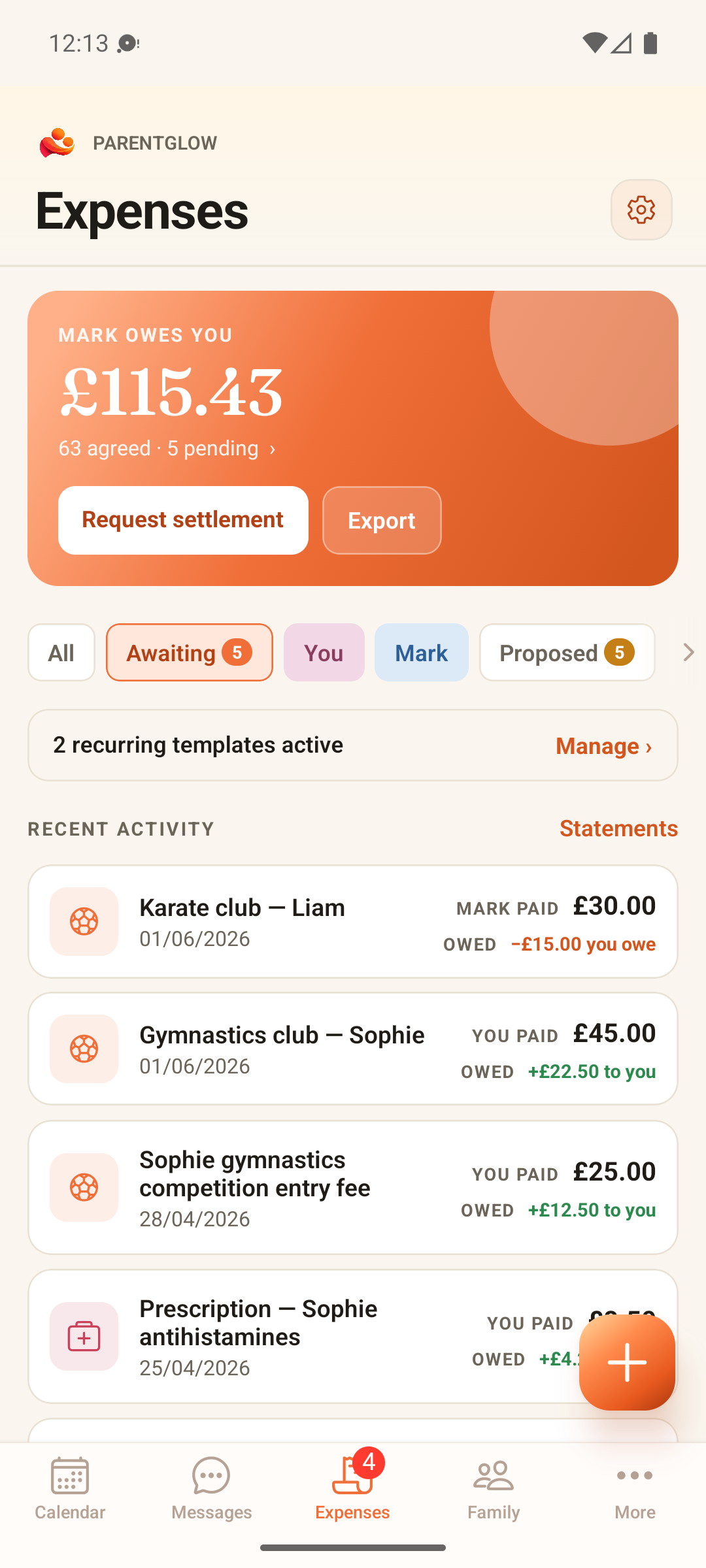
An agreement only stays fair if it's tracked. ParentGlow's fair expenses lets either parent log a cost, split it by the percentage you agreed, and attach the receipt — so every spend has proof and a clear share.
Set a default split per category, keep big spends behind a quick yes, and watch a single running balance tick up and down until someone settles up. When you need it, export a tidy statement of who paid for what. “Who paid for the school shoes?” always has an answer.
See fair expenses → · Choose a shared-expense app → · Agree the split in your plan →
Honest pricing
One plan covers both parents.
No per-parent charge: ParentGlow is one subscription that covers both of you, with sitter links for grandparents and childminders at no extra cost. The calm place to keep the costs fair and tracked.
Common cost questions
Splitting the costs, answered.
How do separated parents split the children's costs?
Commonly 50/50, in proportion to what each parent earns, or by category (a set split per type of cost — say medical down the middle, clubs another way). Agree what feels fair between you, write it down, and track it so it stays fair over time.
Is splitting costs the same as child maintenance?
No. Child maintenance is regular support for a child's everyday living, arranged privately as a family-based arrangement or through the Child Maintenance Service — see GOV.UK for that. Shared costs are the extra things — clubs, trips, uniform, kit — that you split on top. This guide is about those shared extras, not maintenance. This is general information, not legal or financial advice.
How do you handle big or unexpected costs?
Agree a threshold above which a cost needs a quick yes from the other parent first — so nobody's landed with a surprise bill for the school trip or the new boots. Small everyday things just follow the split you already agreed.
What's the easiest way to keep it fair?
Track each cost with the receipt attached, apply the split you agreed, and settle up to a clear running balance — rather than totting up receipts from memory. Then 'who paid for the school shoes?' always has an answer.
Bring the calm home.
Free during early access — a hello, the odd update, and one email when it's your turn.
Almost there. Check your email and tap the link to confirm.
Free during early access · one plan covers both parents · unsubscribe anytime