

Early access
Bring the calm home.
One plan covers both homes. A hello, the odd update, and one email when it's your turn.
Almost there. Check your email and tap the link to confirm. 
Free during early access · one plan covers both parents · unsubscribe anytime
Money · UK families
Shared child expenses, in one clear place.
When both homes pay for school shoes, clubs, trips and the everyday extras, the hard part is often not the maths. It is knowing what was agreed, what has been paid and what still needs a conversation. A co-parenting expense tracker gives both parents one shared view, so less is left to memory.

The useful bits
What a shared-expense app should make simpler.
The best co-parenting app for expenses is not the one with the longest feature list. It is the one that makes the ordinary questions easier for both parents to answer in the same way.
One shared list
Each cost should live in the same place, with the date, amount and a short explanation. That gives both homes the same starting point instead of two private lists.
The split you agreed
A helpful tracker applies the split you have already chosen, whether that is equal, by category or another proportion you both understand. The app should not decide what is fair for you.
Receipts and context
A receipt, school letter or short note can answer a future question without turning it into a search through old messages. Keep only the information you both need to understand the cost.
A clear running balance
Both parents should be able to see what has been paid, what is awaiting agreement and what is left to settle. Clarity is more useful than a complicated spreadsheet.
Before a cost is logged
Agree the small rules first.
An app can hold the record, but it cannot create the agreement. A few plain rules before you start can make the shared list feel less like an audit and more like practical family admin.
Name the shared categories
For example, school items, activities, childcare and agreed health costs. You do not need to share every spend, only the kinds of cost you both decide belong on the list.
Set an approval point
Choose when a parent should ask first, especially for a larger or recurring cost. That can prevent a surprise request after money has already been spent.
Choose a settling rhythm
Decide whether you will settle as costs arise or check the balance at an interval that works for you. The important part is that the rhythm is clear to both homes.
For a fuller practical guide, read splitting children's costs after separation.
Keep the distinction clear
An expense tracker is not a maintenance decision.
A shared record can help with the costs you agree to track. It is not a child-maintenance calculator, a legal agreement or a way to decide what either parent owes.
GOV.UK says parents can make a private arrangement about how to cover a child's living costs when both agree. It gives examples including paying for school uniform, trips or clubs. GOV.UK also says the arrangement is flexible and can change if circumstances change. Use its current guidance for child maintenance itself rather than relying on an app or this page.
GOV.UK: making a private child-maintenance arrangement
This guide is general information, not legal or financial advice. ParentGlow does not calculate, decide or enforce child maintenance.
About ParentGlow
Designed for the shared costs you agree.
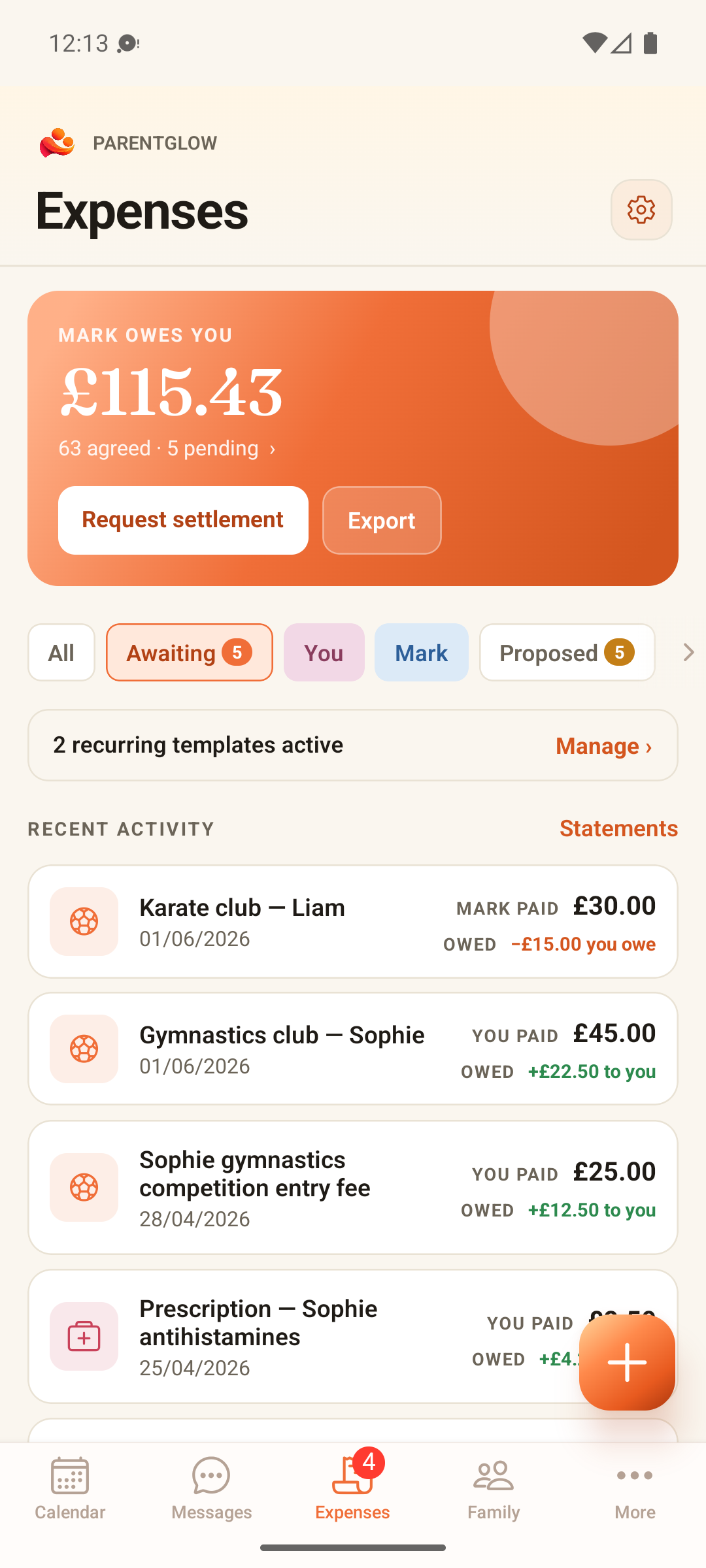
ParentGlow makes a co-parenting app, so we have a direct interest in this choice. Its Fair Expenses feature is designed to help both parents log a cost, apply an agreed split, attach a receipt and see one running balance.
It can also keep a cost awaiting agreement before it is treated as shared. That may suit parents who want an ordinary place to record the practical detail without using a general chat thread as their money list. It is not a replacement for an agreement, legal advice or support where a conversation is unsafe.
Quick answers
Shared expense questions, answered.
What should a co-parenting expense tracker record?
A useful shared record names the cost, who paid, the agreed split, whether the other parent needs to approve it and any receipt or note that explains it. The aim is for both parents to see the same current information.
Is a shared-expense app the same as child maintenance?
No. GOV.UK describes child maintenance as support parents can arrange privately or through the Child Maintenance Service. A private arrangement can include agreeing who pays for items such as school uniform, trips or clubs. An expense tracker can help parents record what they have agreed, but it does not calculate, decide or enforce child maintenance.
What makes a co-parenting app good for shared child expenses?
Look for a simple shared view, a clear agreed split, space for receipts or notes, a way to flag a cost before it is committed, and a running balance that both parents can understand. The best choice is one both homes are willing and able to use.
What if it does not feel safe to discuss money with the other parent?
Do not rely on an app to make an unsafe conversation safe. GOV.UK says a parent who feels at risk talking to the other parent may be able to use the Child Maintenance Service. For immediate danger, call 999. Specialist domestic-abuse support can help you think about the safest next step.
Source read 18 September 2026: GOV.UK, make a private child-maintenance arrangement. This guide is general information, not legal or financial advice.
Related: Child costs after separation → · Splitting children's costs → · All guides →
Keep thecostsclear.
One shared view can make the practical money questions less likely to become an argument.
Almost there. Check your email and tap the link to confirm.
Free during early access · one plan covers both parents · unsubscribe anytime