

Early access
Bring the calm home.
One plan covers both homes. A hello, the odd update, and one email when it's your turn.
Almost there. Check your email and tap the link to confirm. 
Free during early access · one plan covers both parents · unsubscribe anytime
Co-parenting · communication
How to communicate with your co-parent (without it boiling over).
Talking to an ex is hard — sometimes the hardest part of the whole thing. This is the practical guide to keeping it calm, child-focused and business-like, even with a high-conflict ex: the habits that lower the temperature, why putting it in writing helps, and the tools that take the heat out of every message.
Practical guidance for everyday co-parenting — not legal or clinical advice.
Dealing with a high-conflict ex ↓
- Child-focused & brief
- Keep a clear record
- Lower the temperature

Why it's so hard
Why talking to an ex is so hard after separation.
If every message feels loaded, you're not doing it wrong — it's genuinely hard. The old patterns are still there, the feelings are still raw, and the same words that used to start a row still can. The goal isn't to be friends again. It's a workable working relationship for the children — and that's a much lower bar to clear.
Once you stop aiming for warmth and start aiming for functional, a lot of the pressure lifts. You don't have to like the conversation. You just have to get the children's logistics sorted and keep the temperature down while you do it. Everything below is built around that one idea.
The ground rules
The ground rules that actually work.
You don't need a communication course — you need a few habits you can repeat on a bad day. These are the ones separated parents come back to again and again.
-
Keep it child-focused
Every message is about the children, not about the two of you. If it isn't about their day, their health or their schedule, it probably doesn't need sending.
-
Keep it business-like
Treat it like a polite work email: brief, informative, friendly, firm. Stick to facts and logistics, leave the history out of it, and you'll get fewer rows back.
-
One topic per message
Handover times, the dentist, the school trip — keep them separate. One subject per message is clearer, easier to answer, and far harder to derail.
-
Don't reply angry — draft, wait, send
If a message lands badly, write your reply, then leave it. Come back in an hour. The version you send after a walk is almost always the one you'd stand behind. You don't have to be on call all evening, either: quiet hours in ParentGlow stop the message pings during the hours you choose.
A useful shorthand for all of it: brief, informative, friendly, firm. If a message is all four, it's ready to send.
The hardest case
Communicating with a high-conflict ex.
When every exchange turns into a fight, the aim shifts. You're not trying to win it or fix them — you're trying to lower the contact surface and protect the children from the noise. These habits are how parents do exactly that.
-
One channel, in writing
Pick a single written place for everything and let texts, calls and WhatsApp go quiet. Fewer doors means fewer flashpoints — and one clear record of what was actually said.
-
Stay factual — grey-rock
Be politely unremarkable. Answer the practical question, leave the jibe alone, and give nothing to react to. Emotionally "boring" is the goal, not cold — there's just nothing there to bait.
-
Don't take the bait
A provocation isn't a question — you don't have to answer it. Reply to the logistics, ignore the dig, and you quietly take the heat out of the whole exchange.
-
Never argue through the children
The children aren't messengers, and they aren't a battleground. Keep adult disagreements between adults — in writing, in one place — so they never have to carry them.
And when it tips into abuse, the rules change: it isn't yours to win. Disengage, keep everything in writing, and get support that fits your situation — there's a careful signpost for that further down.
Put it in writing
Why a written, timestamped record helps.
The single biggest calmer is simple: write it down. Once it's in writing, memory stops being the referee.
When the agreement is there in black and white, "I never agreed to that" quietly loses its power — and so does "I never said that". A timestamped record settles the small disputes before they grow, which means there's far less to argue about in the first place. It keeps you honest and calm too: knowing a message is permanent is a gentle nudge to keep it measured. None of this is about building a case against anyone. It's just that when the everyday facts aren't in doubt, the everyday temperature stays low.
What records should I keep? → · Can text messages be used in family court? → · When less contact is the calm option: parallel parenting → · Agree discipline across two homes →
Tools that take the heat out
One calm place for the day-to-day.
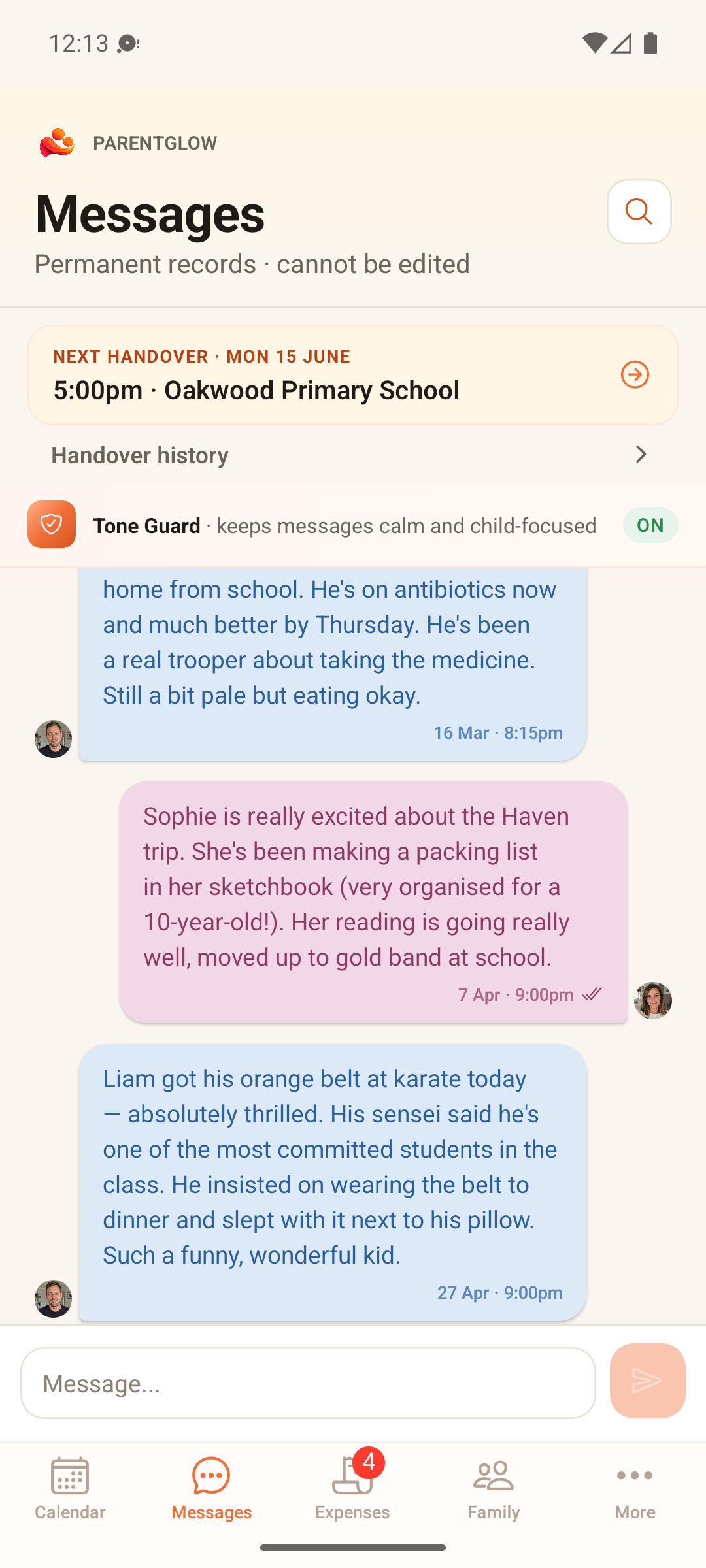
Good habits are easier with the right place to use them. ParentGlow's calm messaging keeps the day-to-day in one spot, so it doesn't spill into texts and WhatsApp at all hours — and Tone Guard gives a heated message a quiet check as you type.
Tone Guard flags wording that might read as heated, and on a flagged message you can tap for a calmer version to use, change or ignore. It never stops you sending a message or a handover note, and only the words of your draft are checked. Every message is a permanent, timestamped record with read receipts, so "I never saw that" stops being a thing, and "What we agreed" keeps the arrangements clear for both homes.
See calm messaging & Tone Guard → · Agree how you'll communicate →
When to get more help
When to get more help.
Some things are bigger than message habits — and reaching for help isn't failing at it, it's part of doing it well.
If you keep getting stuck on the same points, family mediation can help you reach workable arrangements without going to court. If your disagreement involves a child, the Family Mediation Voucher Scheme may contribute up to £500 towards eligible mediation sessions in England and Wales, subject to suitability and availability. GOV.UK also explains how to make child arrangements.
And a careful note: if you feel unsafe, or there's abuse, this is beyond app tips. Keep contact written and minimal, and reach out to a support service that can help with your situation — you don't have to handle it alone. If you or your children are in immediate danger, call 999.
This guide is practical communication advice, not legal or clinical advice.
Honest pricing
One plan covers both parents.
ParentGlow — the calm place to keep it all — is one subscription that covers both parents, with sitter links for grandparents and childminders at no extra cost. No per-parent charge, and your record is always yours to take.
See pricing → · See the UK co-parenting app → · Can Teams work for co-parenting? →
Communication questions
Common questions about co-parenting communication.
How should you communicate with a difficult co-parent?
Keep it child-focused, business-like and brief. Stick to facts and logistics, one topic per message, and use a single written channel so there's a clear record. Don't reply in anger — draft it, wait, then send. A quick tone check before sending helps keep things calm.
What is grey-rock or BIFF in co-parenting?
They're simple ways to stay calm with a high-conflict ex. BIFF means keeping replies brief, informative, friendly and firm. Grey-rock means being emotionally "boring" — factual rather than reactive — so there's nothing to bait. You answer the practical question and leave the provocation alone.
Should co-parenting communication be in writing?
Usually, yes. A permanent, timestamped written record keeps everyone honest and calm, and means agreements aren't lost to memory. "I never agreed to that" loses its power when the message is right there — and writing it down keeps you measured too.
What if my ex is abusive?
App habits aren't the answer to abuse. Keep contact written and minimal, and reach out to a support service for help specific to your situation. If you or your children are in immediate danger, contact the police on 999. This guide is practical communication advice, not a substitute for that support.
Bring the calm home.
Free during early access — a hello, the odd update, and one email when it's your turn.
Almost there. Check your email and tap the link to confirm.
Free during early access · one plan covers both parents · unsubscribe anytime